Mission Autonomy in Mine Countermeasures: Coordinating the Uncrewed Fleet
In an era of contested seas and reduced tolerance for risk, mission level autonomy has become the backbone of effective defence operations.
The rapid evolution of maritime mine warfare has driven navies to adopt increasingly autonomous approaches to mine countermeasures (MCM) and explosive ordnance disposal (EOD). As fleets move away from single‑platform operations toward coordinated teams of robotic and autonomous systems (RAS), the requirement for robust mission‑level autonomy software has become critical to reduce risk to personnel, accelerate mission timelines, and operate effectively in contested or communications‑degraded environments. SeeByte’s Neptune software has emerged as a key enabler in this space, specifically tailored to complex defence environments. Already adopted by the US, UK, and Dutch Navies, Neptune represents a significant step forward in the orchestration of multi‑vehicle autonomous missions.
Mission‑Level Autonomy Designed for Defence
Neptune is not a vehicle controller; rather, it operates at the mission level, coordinating squads of heterogeneous Remote and Autonomous Systems (RAS) to achieve complex operational objectives. The software assigns goal‑based plans and objectives according to the individual capabilities of each asset, ensuring that every platform is employed where it is most effective. By automating task allocation and coordination, Neptune augments human decision‑making and allows operators to focus on mission outcomes rather than vehicle micromanagement.
A defining feature of Neptune is its ability to run multiple tasks in parallel, dynamically reallocating responsibilities as conditions evolve. Vehicles can automatically take ownership of tasks, swap roles, or compensate for malfunctions, significantly improving mission resilience. This approach is particularly valuable in mine warfare scenarios, where environmental uncertainty and operational tempo demand rapid adaptation.
Decentralised Control for Contested Environments
Mine warfare operations frequently take place in communications‑restricted or denied environments, where reliance on constant links to a central control station is neither realistic nor desirable. Neptune addresses this challenge through a decentralised autonomy architecture, allowing vehicles to continue operating even when communications are degraded or intermittent.
On‑board artificial intelligence enables in‑mission adaptation, allowing Neptune to respond to changes in mission objectives, environmental conditions, or vehicle availability. RAS, operating under Neptune’s control, collaborate and adjust their behaviour autonomously to ensure mission success, a critical capability for modern naval forces operating in complex littoral and expeditionary environments.
Proven Application in Mine Countermeasures and EOD
Neptune has been specifically developed with MCM and EOD missions in mind and is already operationally proven in this domain. Its ability to coordinate multiple unmanned platforms makes it well suited to distributed mine hunting, classification, and re‑acquisition tasks. By integrating sensor data, mission planning, and adaptive tasking, Neptune enables a more efficient and safer approach to mine warfare, reducing the need for crewed vessels to operate in hazardous areas.
The software supports a wide range of sonar and sensor formats commonly used in mine warfare, including side scan sonar from EdgeTech, Kraken Synthetic Aperture Sonar (SAS), Klein (MIND‑Technology), as well as forward‑looking sonar such as Teledyne BlueView. This broad sensor compatibility ensures Neptune can be deployed across existing and future naval RAS fleets.
Integration with Third‑Party Vehicles and Systems
A key strength of Neptune lies in its commercially controlled open architecture. Rather than locking users into proprietary ecosystems, Neptune is designed to integrate seamlessly with third‑party vehicles, sensors, autonomy behaviours, and signal processing functions. This is achieved through SeeByte’s Software Development Kit (SDK), which allows defence organisations and industry partners to tailor Neptune to their specific operational needs.
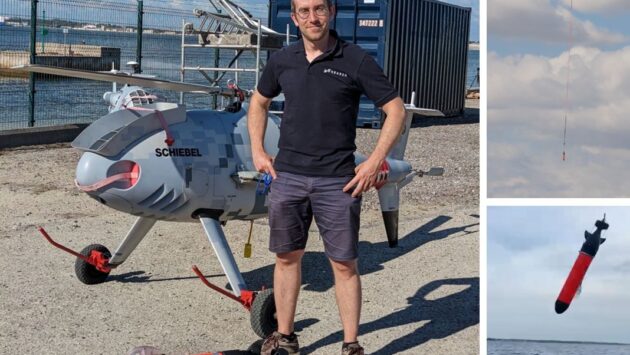
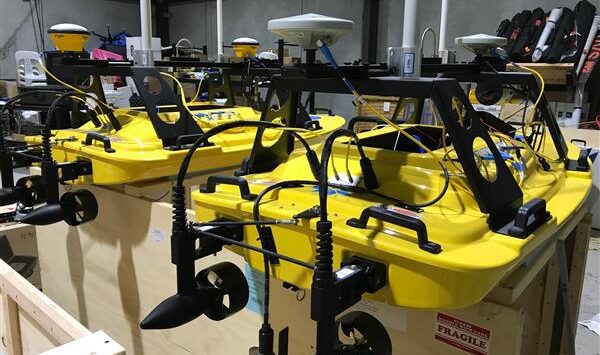
Neptune currently supports a variety of widely used unmanned platforms, including HII REMUS, ATLAS SeaCat, and MARTAC Mantas vehicles. This demonstrates its suitability for mixed‑fleet operations, where different classes of autonomous systems must work together under a single mission framework. Such interoperability is increasingly important for allied and coalition operations, where platform diversity is the norm rather than the exception.
Scalable Architecture from Edge to Mission Command
From a systems perspective, Neptune is designed to operate across a range of hardware configurations, from embedded processors onboard vehicles to operator workstations. The software can run on lightweight embedded platforms such as Intel Atom or Raspberry Pi systems and can be scaled to more powerful configurations using NVIDIA Jetson hardware when AI/ML capabilities such as automatic target recognition (ATR) are required.
Neptune integrates with SeeByte’s SeeTrack environment, providing a coherent ecosystem for mission management, situational awareness, and data exploitation. Support for standard geospatial formats, including S‑57 and S‑63 ENC, ESRI Shapefiles, and GeoTIFF, ensures compatibility with naval charting systems and existing command‑and‑control workflows.
Australian Representation through BlueZone Group
For Australian defence, BlueZone Group serves as the local representative for SeeByte, providing access to Neptune and the broader SeeByte autonomy portfolio. Through this partnership, Australian naval and defence organisations can engage directly with a proven, internationally adopted mission‑level autonomy solution while benefiting from local expertise, support, and integration capability.
As Australia continues to invest in autonomous and uncrewed systems for maritime security, mine countermeasures, and force protection, Neptune offers a scalable and interoperable software backbone capable of integrating with both current and future RAS platforms. The combination of SeeByte’s operationally proven autonomy software and BlueZone Group’s Australian presence positions Neptune as a compelling solution for sovereign and allied defence applications.
For more information on SeeByte’s Neptune Sotftware, please Contact the BlueZone Group sales team.
Read More:
SeeTrack: The Defence Ready Command and Control System for Maritime Autonomy
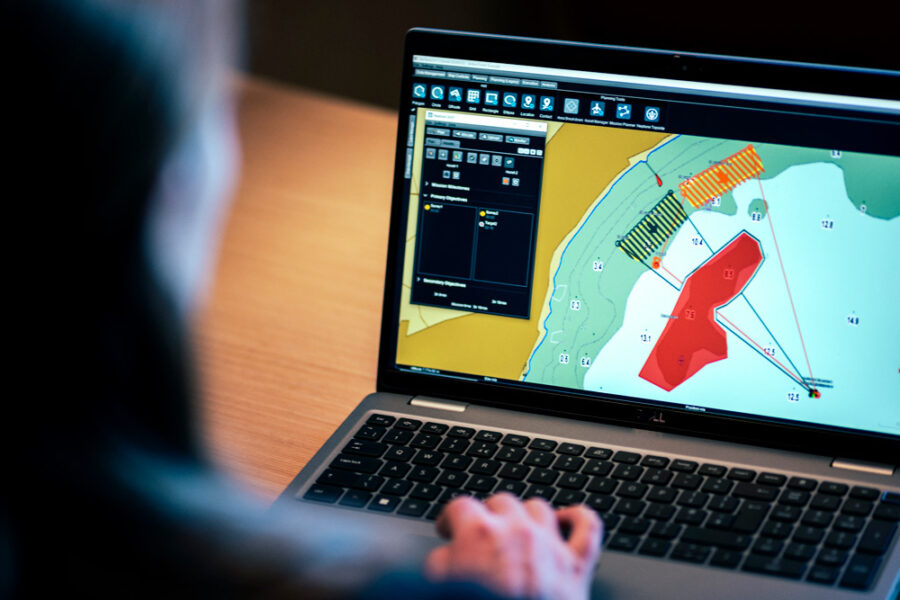
Neptune Software (Photo credit: Seebyte).