Pop-Up Buoy Recovery System for Benthos Releases
Deepwater Buoyancy has announced the Pop-Up Buoy Recovery System (PUB) is designed to work with both the legacy Teledyne Benthos 875 shallow water release, as well as the new R500 series release.
“Teledyne Benthos has discontinued its long-standing product offering, the PUB-875,” explained David Capotosto, Director of Business Development. “This left our distributors and the end users in a supply dilemma. We saw this change and the introduction of the new R500 release from Benthos as an opportunity to serve our clients and, at the same time, to improve the concept. As with all DeepWater Buoyancy designs, the unit is thoughtfully designed and ruggedly-built for the offshore environment.”
DeepWater Buoyancy’s Pop-Up Buoy Recovery System (PUB) allows for direct retrieval of seabed packages, such as anchors, anchor lines, and bottom-mounted frames and instruments. Easily mounted to any framework, the assembly sits on the seafloor until the acoustic release is activated. Once the release completes its disconnection, the buoy sub-assembly lifts free from the canister sub-assembly and rises to the surface. A synthetic line connects the buoy directly to the framework of the seabed item and allows for retrieval.
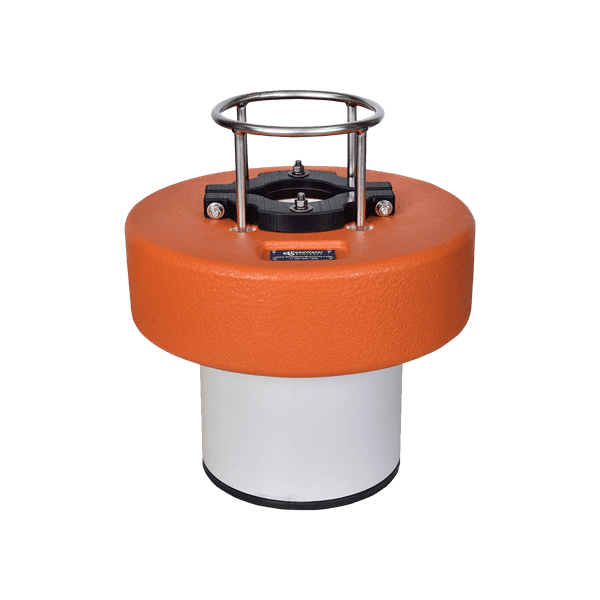 |
| The standard recovery system is designed to work with both the legacy Teledyne Benthos 875 shallow water release, as well as the new R500 series release. |