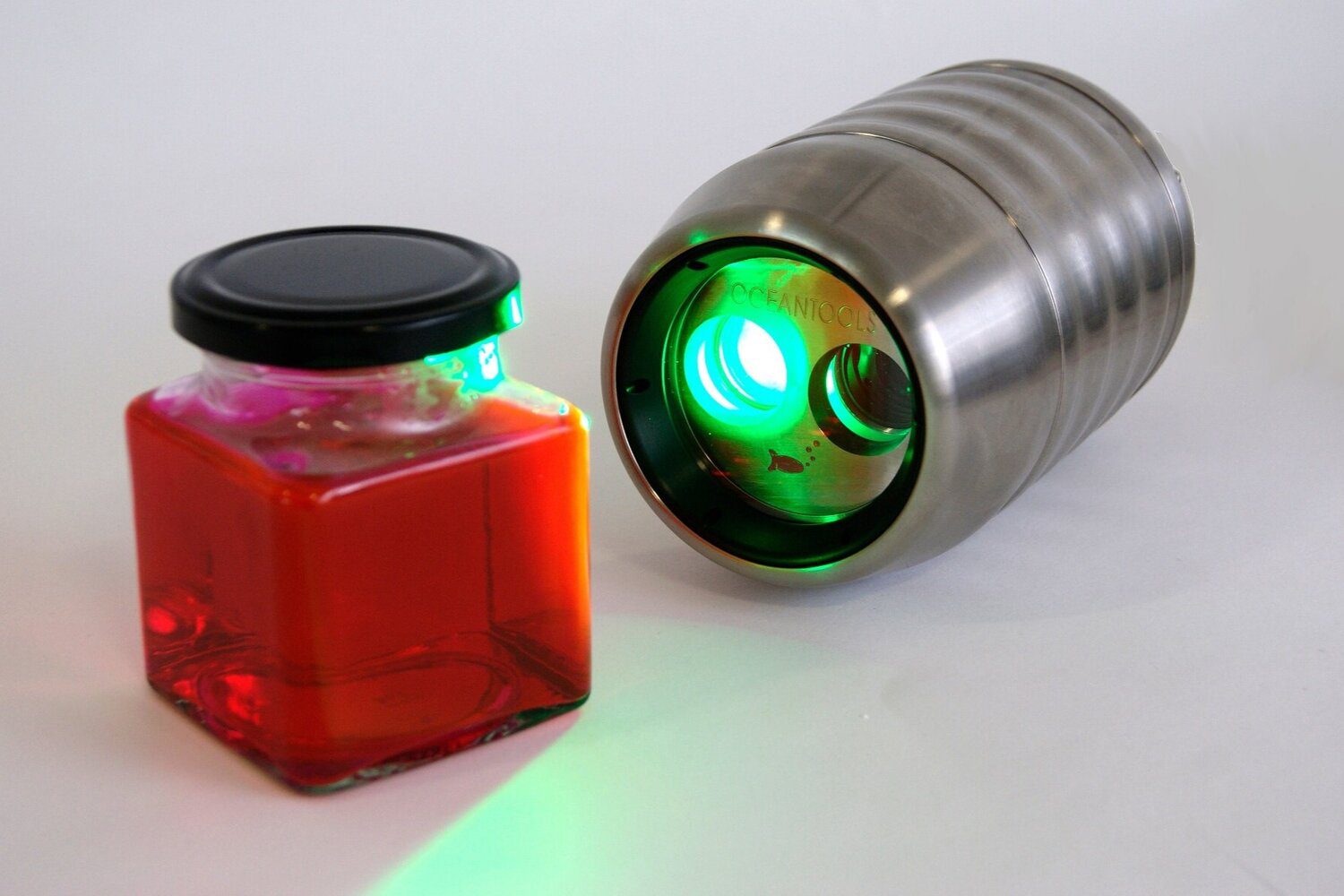
The D7 DyeTector is a state of the art subsea leak and dye detector. High-power LED light is focused through lenses and filters to create a concentrated beam that is tuned to a specific wavelength to cause maximum fluorescence of the dye. Detection electronics employ clever light amplification technology to amplify even the smallest amounts of fluorescence from the agitated dye molecules.
The powerful ROV mounted D7 DyeTector uses a new technology capable of detecting single photons of light, which enables it to detect down to single digit parts per billion of dye dissolved in water. This makes it ideal for detecting the very smallest of leaks or dye-dosed cement.
A DyeTector may be used to detect leaks from subsea infrastructures such as manifolds, wellheads or pipelines if a suitable dye has been added to the infrastructure fluids. Pipeline or flow line pressure testing can be monitored by the DyeTector if dye impregnated fluids are used.
A DyeTector may also be used during casing cementing operations to detect cement returns if a tracer dye is added to either the seawater spacer or to the cement itself. Unlike pH meters which rely upon the cement passing over them, a DyeTector can detect cement from a distance of several metres depending on the concentration of dye.
Versions of the D7 DyeTector are designed to detect specific types of dye in addition to OceanTools C-Dye and C-Dye 370, including:
Up to 25-hour mission duration
Speeds up to 4.2 knots
Increased module payload capacity
Search and recovery
Hydrography
Deep sea mineral exploration
Marine & Fisheries research
The Xeos Ares Duo is an all-in-one turbidity and chlorophyll-a sensor designed for easy integration to measure key water quality parameters.
Read moreDeepWater Buoyancy understands the value of data recovery, as well as, ADCP technology, oceanographic operations and what it takes to supply products that ensure success.
Read moreEmergency Relocation Transponder for Diving Bells
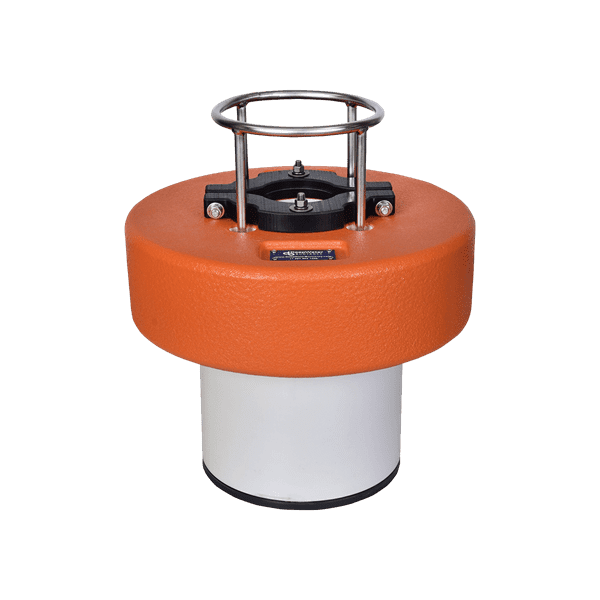
Commercial diving companies operating in an area that requires their diving bell to meet offshore standard DNV-OS-E402, must have an emergency locating system that meets section 305 of that standard.
Read moreEOFY Highlights: Recognising the Achievements of the BlueZone Commercial Team
As we close out another financial year, it’s the perfect moment to reflect on the dedication, passion, and hard work that has defined the BlueZone Group Commercial Team over the...
Read MoreGreensea IQ assert control beneath the waves
$18m contract award will hand divers control of seabed survey and EOD. Since 2023, Greensea IQ has been helping armed forces take control of one of the most difficult...
Read MoreBeyond Line-of-Sight: Enabling Over-the-Horizon Autonomy with USV Relay Architectures
As maritime operations push further into contested and communications-limited environments, the question, “can the Royal Australian Navy project autonomous capability beyond the horizon?”, is looming large. BlueZone Group and SeeByte...
Read More