MARKETS

Case Study: GPS Integration into RiverRay

We are an Australian company with a growing international reputation
focusing on the design and servicing of high quality underwater
electronics used in harsh environments.

Hemisphere A100 Smart Antenna DGPS integrated into RiverRay

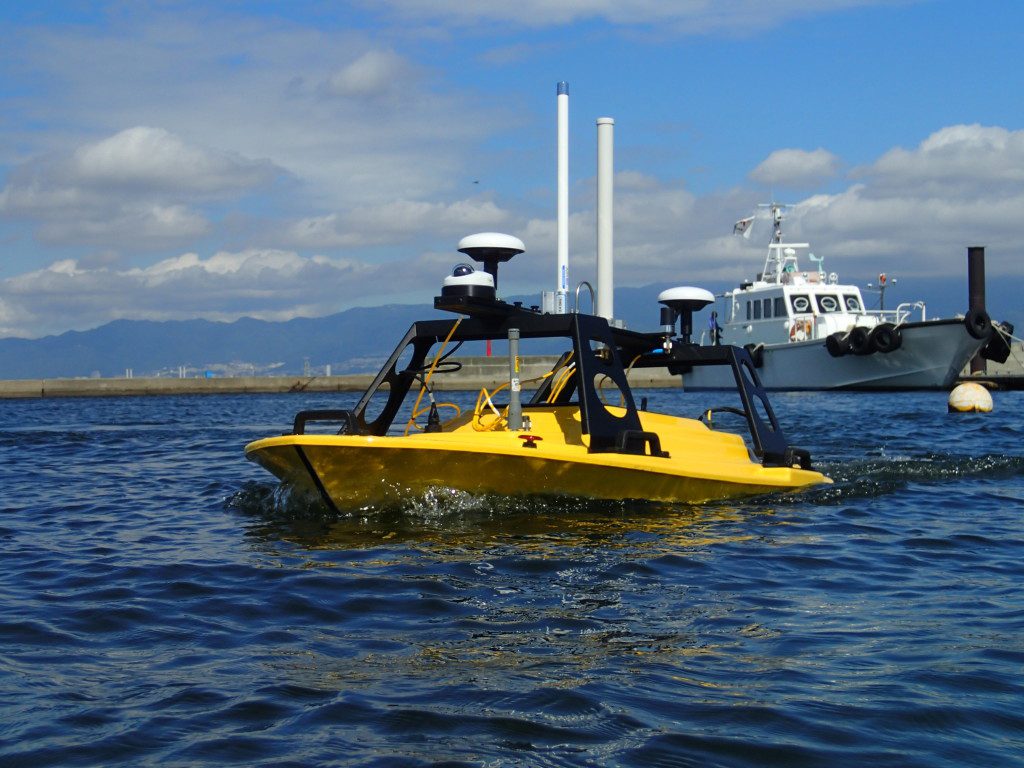
Many users prefer to integrate a GPS into RiverRay for difficult conditions such as moving beds. The RiverRay is fully DGPS compatible and supports integration of a large number of OEM GPS units. The advantage of this approach is that customers can integrate a GPS unit that they already have in their inventory – there is no requirement to include a dedicated GPS in the RiverRay that may not be used for many applications. This reduces cost of ownership.

The RiverRay boat is wired to accept GPS and routes it into the hull via a water proof connector. The GPS data is interleaved into the RiverRay data stream so a single port is all that is required to transmit the data back to your shore station. The result is that GPS and ADCP data are well synchronised.

Differential GPS (DGPS) is recommended with the RiverRay. Differential correction sources commonly available in Australia include RTK (Real-Time Kinematic), and the OmniStar/MarineStar correction services. RTK typically requires dual GPS receivers and a communications link between them, whereas OmniStar/MarineStar only requires a single less expensive receiver.
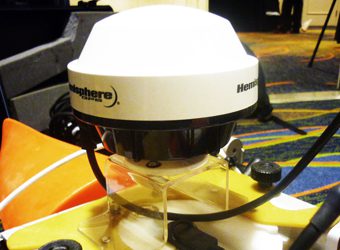

Trimble SPS 351 DGPS integrated into RiverRay
Hemisphere A100 Smart Antenna DGPS integrated into RiverRay

Trimble SPS 351 DGPS integrated into RiverRay

Many users may prefer to select dual frequency RTK GPS units that provide for operational advantages and big increases in productivity in the field. With a dual frequency RTK GPS the base station will converge in approximately 5 minutes and the rover (RiverRay boat) in less than 60 seconds. This can be compared to single frequency RTK units that can require 5 minutes for the base station to converge and a further 5 minutes or more for the rover to converge on differential corrections. If power is cycled or radio communications are lost the rover may need to converge again and this can sometimes take up to 20 minutes. The result can be a frustrating day.

BlueZone Group is pleased to offer the

Fugro Marinestar Differential Global Navigation Satellite System (DGNSS) and corrections signal services. These services can be provided at-sea and for any on-water activities including RiverRay work in lakes, rivers and all inland and estuarine waterways.

Latest News

G’day, Global Navies: Australia’s BlueZone Group Makes a Splash at Farnborough

The Value of Australian Representation at Global Defence Events- Reflections from CNE 2026 BlueZone Group hit the ground running at the Combined Naval Event in Farnborough 2026, bringing a distinctly...

Read More

Beyond Line-of-Sight: Seebyte Enabling Over-the-Horizon Autonomy with USV Relay Architectures

As maritime operations push further into contested and communications-limited environments, the ability to project capability beyond the horizon is becoming a defining advantage of modern naval forces. For decades, underwater...

Read More

Handheld Control, Mission-Ready: ArtemisHHC Redefines Underwater ROV Operations

The introduction of Blueprint Subsea’s ArtemisHHC (Handheld Controller) marks a significant step forward in underwater operational capability for divers operating within defence and specialist maritime environments. Officially launched at SOF...

Read More

Expanding Hydrographic Capability in Inland Waters with the Trident USV

Unlocking high-resolution hydrographic survey capability in even the most constrained inland waterways, the Trident USV is redefining how data is captured where traditional vessels cannot operate. As hydrographic surveying pushes...

Read More