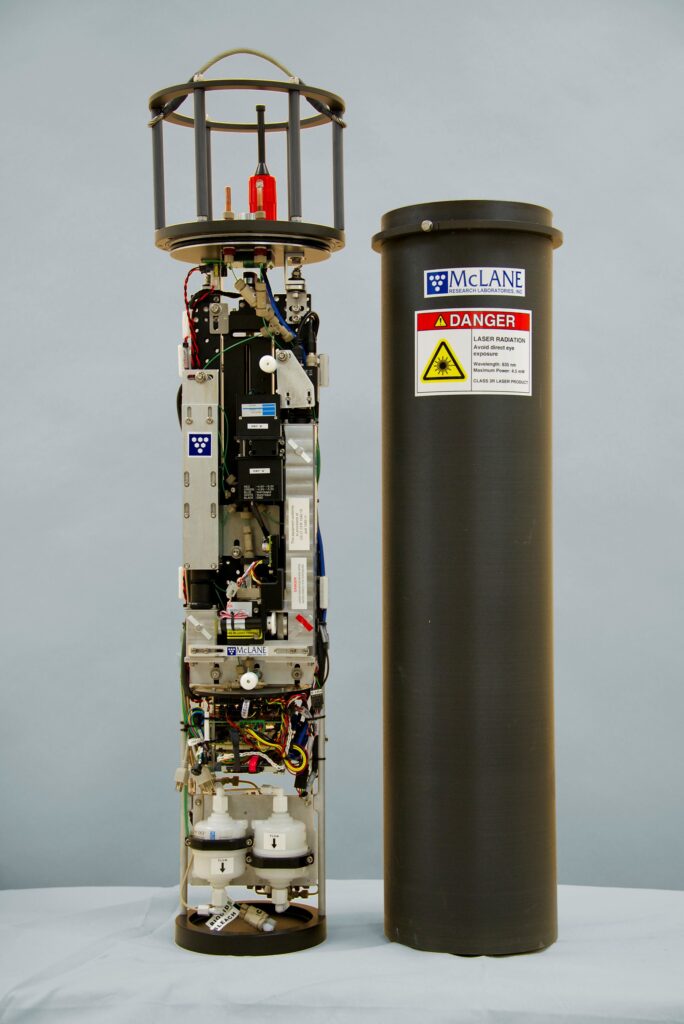
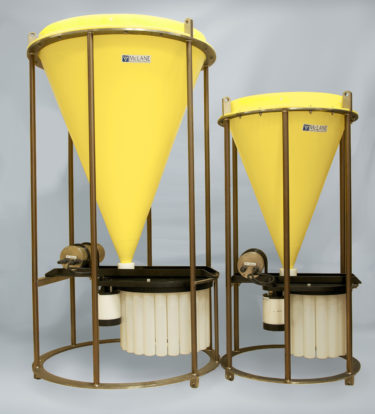
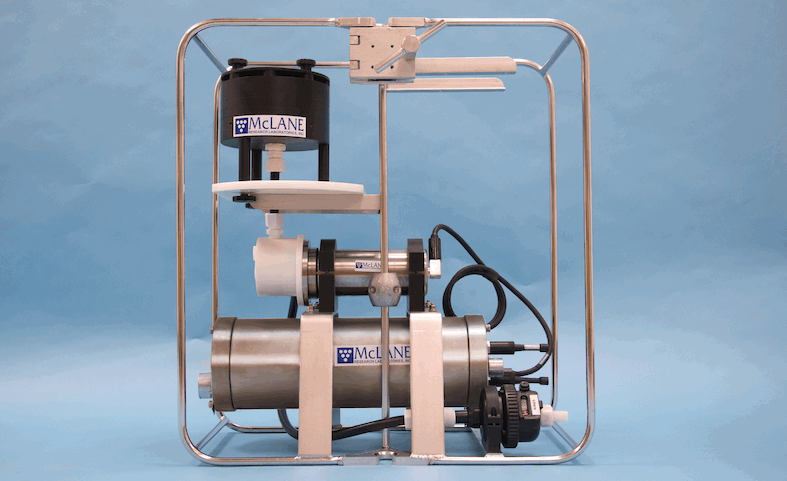
The Parflux Sediment Trap collects the export flux of settling particles in oceans and lakes. The wide collection funnel features a hexagonal grid top. The Sediment Trap stores samples in individual sample bottles. Sampling is pre-programmed or adaptively triggered from an on-shore device.
• Maximum depth: 7,000m (10,000m deep model available).
• Number of samples: 13 or 21 of 250mL or 500mL.
• Models: Standard models collect 13 or 21 samples, the Mk8-13 model is half the size of standard models and collects 13 samples of 250mL or 500mL.
• Options: Wet Sample Divider (WSD-10) to split wet samples, Ethernet communication, tilt sensor, and pressure sensor.
Up to 25-hour mission duration
Speeds up to 4.2 knots
Increased module payload capacity
Search and recovery
Hydrography
Deep sea mineral exploration
Marine & Fisheries research
McLane RoCSI – Robotic Cartridge Sampling Instrument
The McLane RoCSI (Robotic Cartridge Sampling Instrument) is a cutting-edge biomolecular sampler designed for in situ collection and preservation of particulate samples, including genetic material and environmental DNA (eDNA).
Read moreThe Large Volume Water Transfer System (WTS-LV) collects a single suspended particulate sample in situ onto 142mm filter media. Collection studies include particulate trace metals and hydrothermal vent sampling. Flow...
Read moreThe Ice Tethered Profiler (ITP) vertically travels along a fixed mooring wire at 25cm/sec and is suited for (but not limited to) sampling the water column under the ice, collecting...
Read moreDeepSea Power & Light SeaVent®: Protecting Subsea Systems in Extreme Environments
Compact, Reliable Pressure Protection for Critical Systems Subsea and sealed electronic systems operate in some of the most demanding environments on Earth, where pressure differentials, thermal cycling, and depth‑induced stresses...
Read MoreSeaPower. Powered by Kraken, supported by BlueZone Group
BlueZone Group strengthens in‑country sustainment through Kraken SeaPower battery servicing training in Germany As Australia’s maritime autonomous and uncrewed capability accelerates, so does the need for trusted, in‑country sustainment....
Read MoreMission Autonomy in Mine Countermeasures: Coordinating the Uncrewed Fleet
In an era of contested seas and reduced tolerance for risk, mission level autonomy has become the backbone of effective defence operations. The rapid evolution of maritime mine warfare has...
Read More