Beyond Line-of-Sight: Enabling Over-the-Horizon Autonomy with USV Relay Architectures
As maritime operations push further into contested and communications-limited environments, the question, “can the Royal Australian Navy project autonomous capability beyond the horizon?”, is looming large. BlueZone Group and SeeByte have the answer.
For decades, underwater operations have been constrained by a simple reality: to maintain awareness and control, crewed vessels often need to remain close to the systems they deploy. Whether conducting mine countermeasures (MCM), hydrographic survey, or infrastructure inspection, proximity has traditionally been a prerequisite for mission success.
But in an era defined by increasing threat complexity, distributed operations, and the need to minimise risk to personnel and high-value assets, a new operational model is needed. Enter autonomous system swarms: tasking, cooperating and relaying comms beyond line-of-sight.
Modern naval missions demand greater coverage, faster response times, and the ability to operate in contested or denied environments. Meanwhile adversaries are leveraging low-cost, high-impact threats such as sea mines and seabed disruption tactics, increasing the need for persistent monitoring and rapid intervention. However, extending operations beyond the horizon introduces significant challenges. Communications and situational awareness are both reduced significantly, increasing coordination of complicated operations, while exposure for crewed vessels increases. Traditionally these factors have limited the effectiveness and appetite for uncrewed systems, particularly as part of a distributed fleet.
To overcome these limitations, a layered architecture that combines unmanned surface vehicles (USVs) and underwater assets: uncrewed underwater vehicles (UUVs); remotely operated vehicles (ROVs); autonomous underwater ground vehicles (AUGVs); into a cohesive, networked system is increasingly being adopted. The concept is simple, use USVs as forward relay nodes to extend the operational reach of underwater systems. Rather than requiring a crewed vessel to remain within communications’ range of an underwater asset, a USV can act as an intermediary, maintaining communications links, relaying data, and supporting mission coordination from a forward position.
Integrated mission management and autonomy software, such as SeeByte’s SeeTrack and Neptune, enable this architecture, allowing USVs to support multiple underwater assets and facilitate over-the-horizon operations through a distributed control model, fundamentally changing how maritime operations are conducted.
Traditional subsea operations are often platform-centric: a single vessel deploys, monitors, and recovers its assets within a relatively constrained area. By contrast, a USV relay architecture enables a network-centric model, where multiple platforms collaborate across a wider operational space. Under this architecture shore-based or stand-off vessels manage mission objectives and outputs which are relayed through one or more USVs, which act as communications relays and coordination nodes for further autonomous assets. USVs and their assets at the end of the relay carry out the tasks demanded by the crewed command centre, with initial findings and reports being relayed back to complete the loop.
The result is a system that is both more flexible and more resilient. Critically, this architecture allows operations to continue even when direct communication links are degraded or intermittent. By distributing functionality across multiple assets, the system avoids reliance on a single point of control and increases overall mission robustness.
One of the most significant advantages of over-the-horizon operations is the ability to extend reach without exposing crewed platforms to unnecessary risk. In mine countermeasures, for example, keeping ships outside of hazardous areas has always been a priority. By deploying underwater assets forward and maintaining connectivity through USV relays, operators can survey, classify and neutralise targets from a distance while reducing the threat to life from mines and enemy attacks. The reliance on specialist, crewed vessels is also reduced, allowing MCM operations to be conducted from any ship of opportunity available.
Beyond risk reduction, USV-node architectures also enable persistent presence, a critical requirement in modern maritime security. Rather than conducting discrete, time-limited missions, operators can maintain continuous coverage over key areas, returning to the same locations, monitoring for change, and responding rapidly to emerging threats. Port and harbour security, critical underwater infrastructure monitoring and long-term environmental and hydrographic operations benefit from this approach. By enabling underwater assets to operate at range and relay data through USVs, organisations can achieve a level of persistence that would be impractical or prohibitively expensive with crewed assets alone. Which is to say nothing of the force multiplication effect multiple uncrewed nodes can bring to bear.
As the maritime domain becomes increasingly complex, the integration of autonomous systems will continue to reshape operational models. Over-the-horizon capability is not simply about distance—it is about changing how missions are planned, executed, and sustained. More intelligent mission management software, coordination frameworks, open and interoperable system architectures and multi-domain platform integration are enabling a new generation of maritime capability. It’s adaptive, scalable and ready to operate in contested environments.
For Australian operators, the implications are clear. There is no sense in investing heavily in uncrewed systems and autonomous capability unless the ability to integrate these technologies into coherent, networked solutions is also made available. BlueZone Group’s partnership with SeeByte positions Australian defence and industry stakeholders to access and implement these advanced architectures locally, supporting the transition toward distributed, software-driven maritime operations. Over-the-horizon autonomy is no longer a future concept—it is an emerging operational reality, but only if it is correctly and completely implemented.
For those looking to stay ahead of the tide, the question is no longer if these systems will be implemented, but how quickly can they be integrated into the mission?
For more information on the SeeByte SeeTrack and Neptune, please Contact the BlueZone Group sales team.

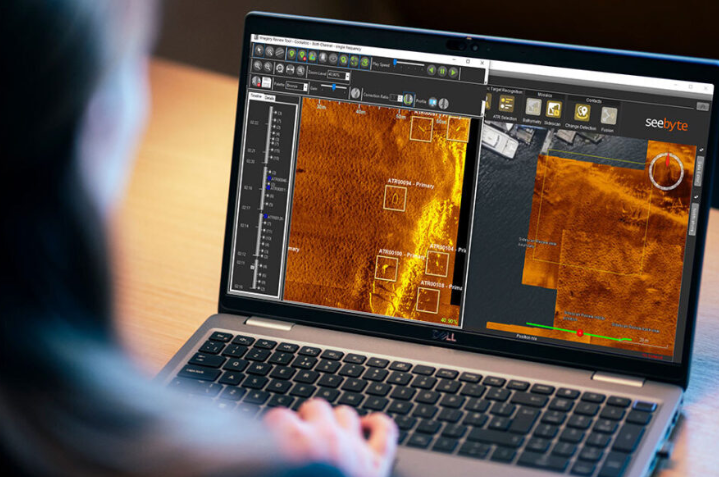
”Contacts’ using SeeBytes SeeTrack Post-Mission Analysis (Photo credit: SeeByte).