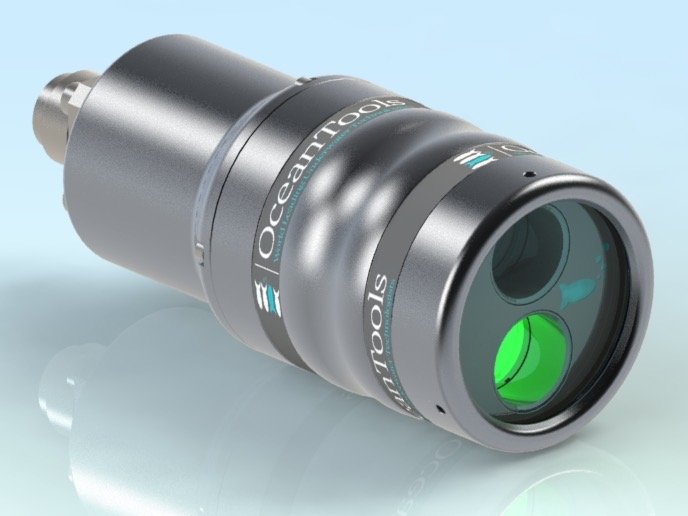
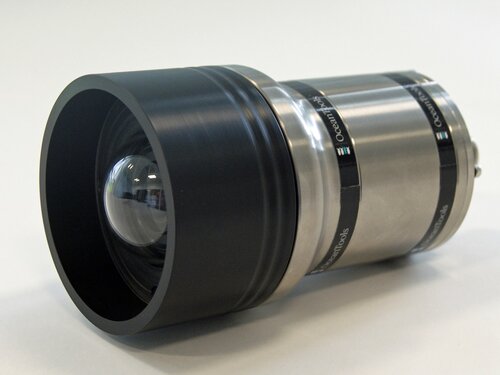
The D5 DyeTector is an advanced ultra-compact subsea leak and dye detection system developed for installation on AUV systems or smaller observation class ROVs.
High-power LED light is focused through lenses and filters to create a concentrated beam that is tuned to a specific wavelength to cause maximum fluorescence of the dye. Detection electronics employ clever light amplification technology to amplify even the smallest amounts of fluorescence from the agitated dye molecules.
The powerful D5 DyeTector uses the same technology capable of detecting single photons of light as larger DyeTector units. This enables it to detect down to single digit parts per billion of dye dissolved in water and makes it ideal for detecting the very smallest of leaks or dye dosed cement. Advanced ambient light suppression technology allows the DyeTector to be used in high levels of background light.
The D5 DyeTector has been specifically designed for installation on AUV systems, with free-running data and low-power electronics to reflect the increasing use of AUVs for pipeline surveys. It can also be deployed on smaller observation class ROVs, with simple and intuitive DyeTection software to display detection data at the surface.
Key Features:
Rhodamine, Fluorescein or Ultraviolet dye detection
Compact design for AUVs or small ROVs
Same powerful DyeTector technology as larger units
Configurable serial control or free-running data output
1000m standard depth rating
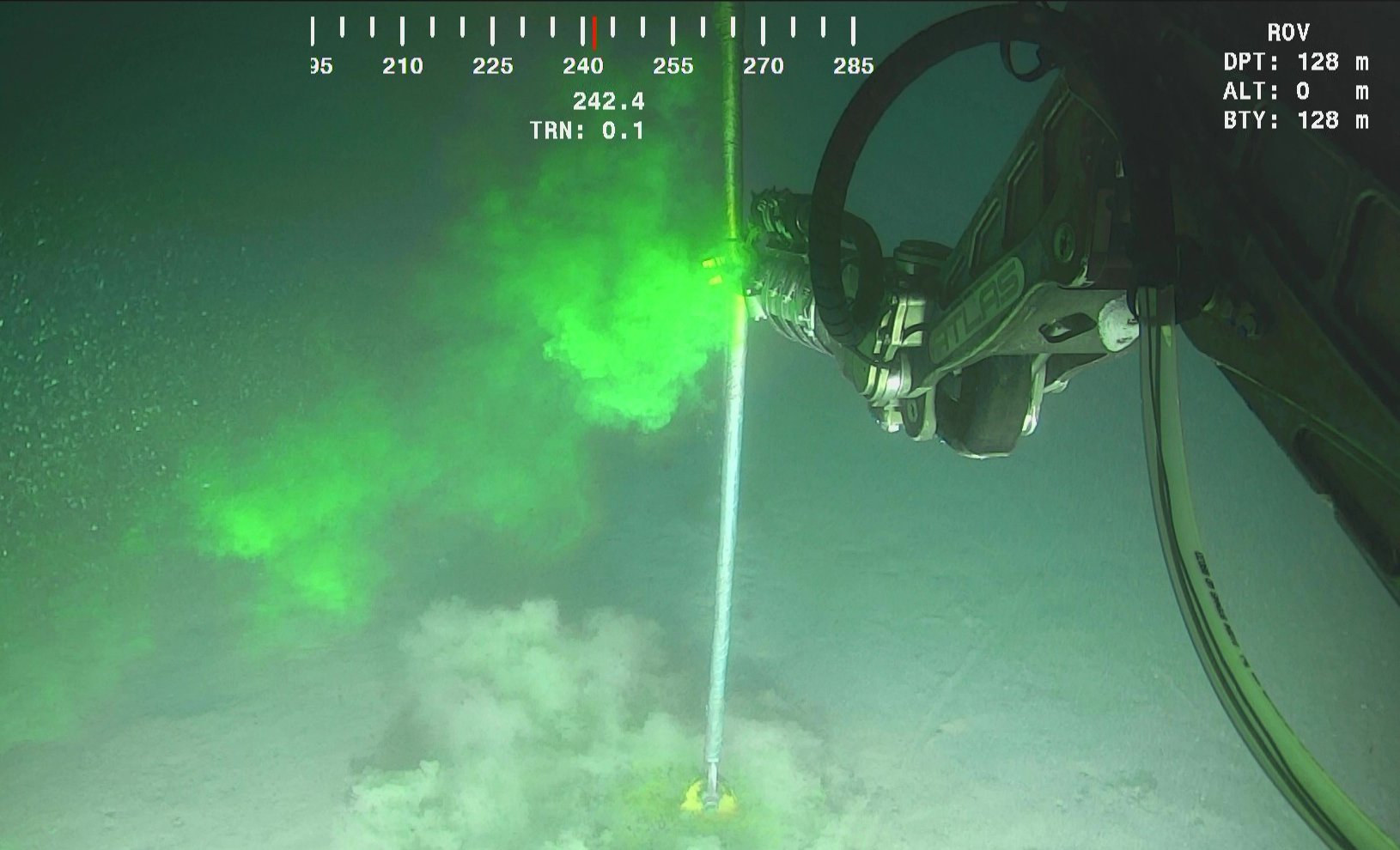
A DyeTector may be used to detect leaks from subsea infrastructure such as manifolds, wellheads or pipelines if a suitable dye has been added to the infrastructure fluids. Pipeline or flow line pressure testing can be monitored by the DyeTector if dye impregnated fluids are used.
A DyeTector may also be used during casing cementing operations to detect cement returns if a tracer dye is added to either the seawater spacer or to the cement itself. Unlike pH meters which rely upon the cement passing over them, a DyeTector can detect cement from a distance of several meters depending on the concentration of dye.
Versions of the DyeTector are designed to detect several types of dye or fluid in addition to C-Dye 530 (Rhodamine) and C-Dye 370 (Ultraviolet) including:
Rhodamine dyes such as B275, RX9022, Pelagic 100 Pink
Fluorescein dyes such as HW443, HW540P, Oceanic Yellow LTF
Ultraviolet dyes such as RX9026E, Pelagic 100, Champion Cleardye, Castrol HT2
List of Detectable Dyes and Fluids
For more information about OceanTools D5 DyeTector, Contact the team at BlueZone.
Up to 25-hour mission duration
Speeds up to 4.2 knots
Increased module payload capacity
Search and recovery
Hydrography
Deep sea mineral exploration
Marine & Fisheries research
DeepSea's Optim SeaCam provides a unique tool for scientists, subsea explorers, and film makers combining superb 4K imaging capability with familiar controls, flexible integration options, and an extremely rugged design.
Read moreDeepSea's Nano SeaCam is a compact, subsea, high-resolution analog camera at 620 TVL that can be used by divers and inspection class ROVs for its size and weight.
Read moreDeepSea's HD Zoom SeaCam has a 30x optical zoom capability, faceplate illumination of 0.024 Lux, and high-quality HD-SDI 1080p/30 video output. Options include a titanium or an aluminum housing.
Read moreEOFY Highlights: Recognising the Achievements of the BlueZone Commercial Team
As we close out another financial year, it’s the perfect moment to reflect on the dedication, passion, and hard work that has defined the BlueZone Group Commercial Team over the...
Read MoreGreensea IQ assert control beneath the waves
$18m contract award will hand divers control of seabed survey and EOD. Since 2023, Greensea IQ has been helping armed forces take control of one of the most difficult...
Read MoreBeyond Line-of-Sight: Enabling Over-the-Horizon Autonomy with USV Relay Architectures
As maritime operations push further into contested and communications-limited environments, the question, “can the Royal Australian Navy project autonomous capability beyond the horizon?”, is looming large. BlueZone Group and SeeByte...
Read More